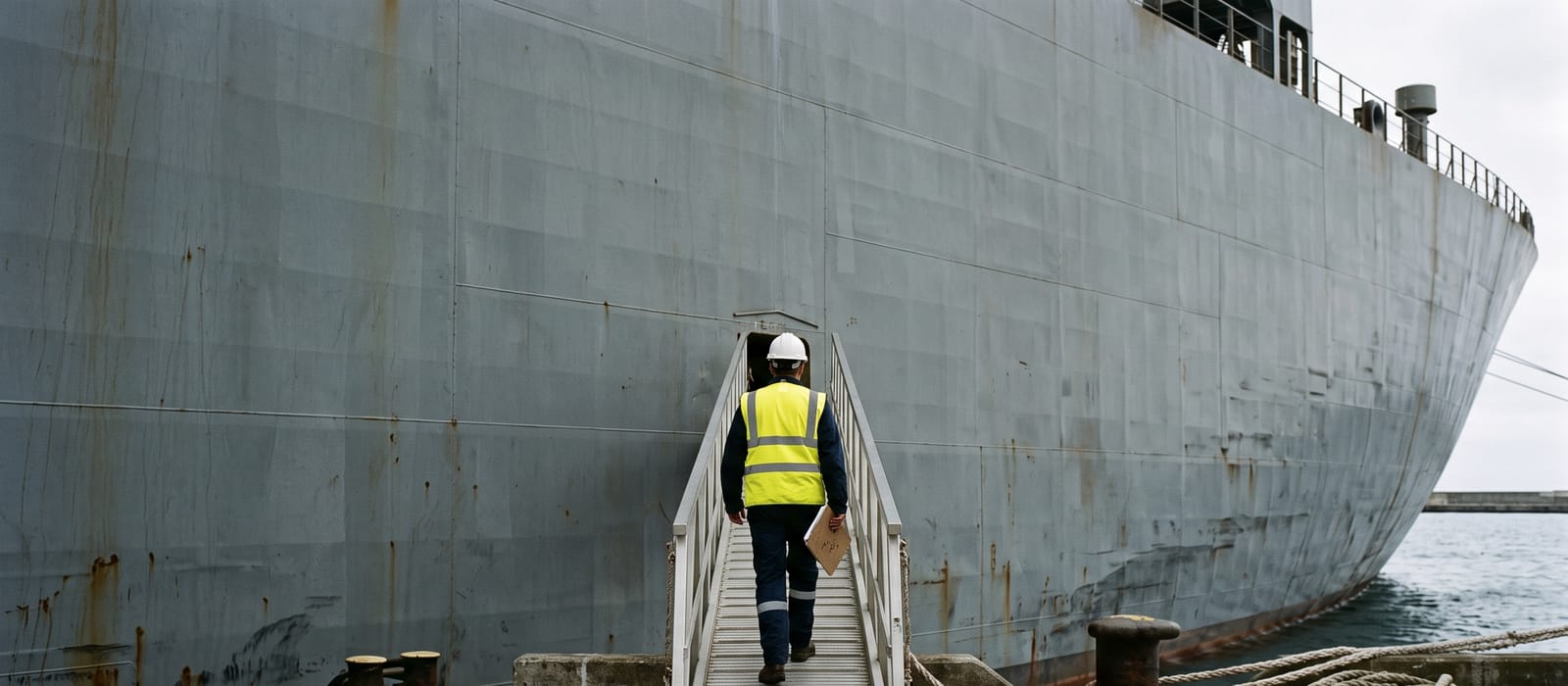
A Port State Control inspection follows a fixed sequence. The officer boards, verifies the ship's certificates, then judges the overall condition of the ship and its crew. If nothing gives "clear grounds" for a closer look, it ends there with a report to the master. If something does, the inspection widens.
What is PSC and who conducts it?
Port State Control (PSC) is the inspection of foreign-flagged ships in national ports to verify that the ship, its equipment and its crew comply with the international conventions: SOLAS, MARPOL, Load Lines, STCW and, in the Paris MoU region, the Maritime Labour Convention among others. The inspecting officer, the PSCO, works for the port State's maritime authority. Not for the flag, and not for class.
The global rulebook is IMO Resolution A.1206(34), the Procedures for Port State Control, 2025, adopted on 3 December 2025 to replace the earlier A.1185(33). Regionally, port States coordinate through Memoranda of Understanding so that a ship is not inspected in every port it calls at. The Paris MoU covers Europe and the North Atlantic, the Tokyo MoU covers the Asia-Pacific, and the United States Coast Guard runs its own programme. This guide follows the Paris MoU version of the process. The other regimes differ in detail, not in shape.
How does a PSC officer decide which ships to target?
Ships are selected by risk, not at random. Every ship in the Paris MoU region carries a Ship Risk Profile: high risk, standard risk or low risk, calculated from ship type, age, flag performance, the recognised organisation behind the certificates, company performance, and the ship's own deficiency and detention history over 36 months. THETIS, the inspection database, recalculates the profile every night. We cover the mechanics in how the Paris MoU Ship Risk Profile works; the practical output is a time window:
| Ship Risk Profile | Next inspection due |
|---|---|
| High risk | 5-6 months after the last Paris MoU inspection |
| Standard risk | 10-12 months |
| Low risk | 24-36 months |
Once the window closes, the ship becomes Priority I and must be inspected at its next port call. Inside the window it is Priority II and may be inspected. Certain events pull an inspection forward regardless of the window. Overriding factors, such as a collision or grounding on the way to port, a report from another member State, suspension from class for safety reasons, or erratic manoeuvring, make the ship Priority I immediately. Unexpected factors, such as a report from a pilot, a complaint from a crew member, or a detention in the past three months, let the authority inspect at its own judgement.
The point for the crew: a boarding is rarely a surprise to the office. The profile, the window and most of the trigger factors are knowable in advance.
What happens when the officer boards?
The PSCO presents an identity card to the master, then starts the initial inspection: checking that the certificates and documents are on board and valid, and forming a view of the overall condition of the ship, including the navigational bridge, forecastle, cargo holds, engine room and pilot transfer arrangements. The officer also verifies that deficiencies from the previous PSC inspection have been rectified.
The procedures instruct the officer both ways. If the certificates are valid and the general impression confirms a good standard of maintenance, the inspection should generally be confined to reported or observed deficiencies. The procedures also state that all possible efforts should be made to avoid a ship being unduly detained or delayed. First impressions do real work here: a tidy engine room and a bridge team that can find its own documents shorten inspections.
Which documents get checked first?
Certificates and documents come before any physical check. The list in A.1206(34) that a PSCO checks as a minimum includes, among others:
- Reports of previous PSC inspections
- Cargo Ship Safety Construction, Safety Equipment and Safety Radio Certificates (or the Passenger Ship Safety Certificate)
- International Load Line Certificate
- IOPP and IAPP Certificates and the International Energy Efficiency Certificate
- International Ballast Water Management Certificate
- International Anti-fouling System Certificate
- International Ship Security Certificate
- Minimum safe manning document and the STCW certificates of masters, officers and ratings
A certificate viewed on a computer on board counts as carried on board. What matters is that each document is valid, endorsed where required, and can be produced without a search. The absence of a valid certificate is itself a clear ground for a more detailed inspection, which makes the document check the fastest way an inspection escalates. A pre-inspection routine that walks this exact list a week early removes the cheapest deficiencies a ship can collect.
When does an inspection escalate to a detailed or expanded inspection?
An inspection escalates when the PSCO finds clear grounds: evidence that the ship, its equipment or its crew do not correspond substantially with the conventions, or that the master or crew are not familiar with essential shipboard procedures for safety or pollution prevention. The procedures give examples: absent or invalid certificates, serious hull or structural deterioration, crew members unable to communicate with each other, unfamiliarity with essential operations. Any of these turns the initial inspection into a more detailed inspection of the areas in question.
The expanded inspection is a separate, scheduled animal in the Paris MoU. It applies to high risk ships and to chemical tankers, gas carriers, oil tankers, NLS tankers, bulk carriers and passenger ships older than 12 years. It covers the risk areas for that ship type plus the human element, and these ships must send a 72-hour pre-arrival notification to the port. An expanded inspection is not triggered by a finding; the ship qualifies for it before the officer ever boards.
What do crew interviews cover?
Familiarity, not theory. The PSCO's benchmark, stated in the procedures, is the minimum familiarization and basic safety training required by STCW. Before asking for any demonstration the officer should review the training and drill records and inspect the associated equipment. If records and equipment hold up, it may end there.
When a drill is sampled, usually fire or abandon ship, the procedures are explicit that the PSCO is not looking for an exceptional drill. The assessment is whether the crew can organize itself into an effective team, communicate, keep the master in control with information flowing to and from the command centre, and get people off the ship safely. The muster list gets checked against reality: current, posted, duties and substitutes assigned. The officer may not impose anything that, in the master's judgement, could jeopardize the safety of the ship.
The reason interviews carry so much weight is where they lead. A crew unfamiliar with its own procedures is clear grounds in itself, and it points at the Safety Management System, the ISM territory where findings become detainable.
What happens after the inspection ends?
The master receives the report of inspection before the ship sails: Form A with the inspection details, and Form B listing each deficiency if any were found. Every deficiency carries a code for what was wrong and an action code for what must happen, from rectification before departure to a 14-day deadline. The codes are worth understanding in their own right, and we break them down in PSC deficiency codes explained.
Most inspections end at this stage. Of the 16,474 inspections in the Paris MoU region in 2025, 9,879 found at least one deficiency and 688 ended in detention, a detention rate of 4.18 percent. If the ship is detained, the flag State and the recognised organisation are notified in writing, and again when the detention is released. A detained ship may in some cases be allowed to sail to the nearest appropriate repair yard under agreed conditions.
Either way, the result goes into THETIS, where it is published and feeds the next morning's Ship Risk Profile. A detention can be contested, but only the flag State or the recognised organisation can request a Paris MoU review, only within 120 days of release, and the panel's findings are not binding. The ship stays detained while any appeal runs.
The inspection itself takes a few hours. The record follows the ship for 36 months, sets the date of the next boarding, and colours how the next officer reads the gangway.