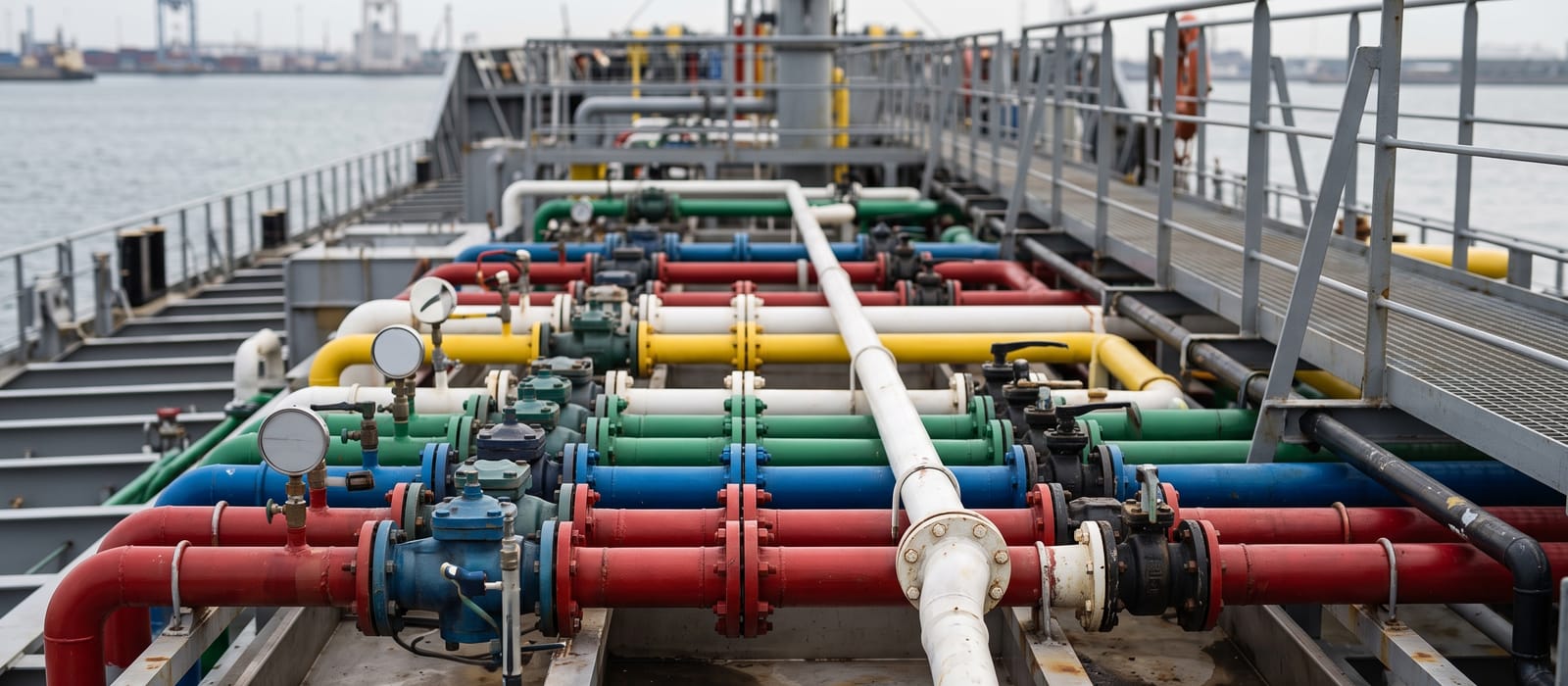
CDI is the chemical industry's own ship inspection scheme, run by the Chemical Distribution Institute, a non-profit foundation the chemical manufacturing industry created in 1994. An accredited inspector works through a fixed questionnaire, the Ship Inspection Report (SIR), and the finished report sits on a database that chemical companies read when they vet a vessel.
What is CDI and which vessels does it cover?
The Chemical Distribution Institute is incorporated in the Netherlands as a non-profit foundation and describes itself as non-commercial and free of political influence: not a trade association, but a safety scheme the chemical industry built for itself. It runs three schemes: CDI-Marine for ships, CDI-Terminals for bulk storage terminals, and a Marine Packed Cargo scheme.
CDI-Marine began with chemical and LPG tankers, and its reach has grown. With the 10th Edition SIR in February 2024 the scheme expanded to LNG carriers, product tankers and dry bulk vessels, and CDI has since added dedicated inspection types for China domestic trade vessels (August 2025) and liquid CO2 carriers (November 2025). For a chemical or gas tanker trading with major chemical companies, a current CDI report is part of the same commercial screening that SIRE serves on the oil side; where both fit in the chain from questionnaire to fixture is covered in charterer vetting explained.
How does a CDI inspection differ from SIRE?
The deepest difference is the questionnaire. SIRE 2.0 compiles a bespoke question set for each vessel from a large question library, so no two inspections are identical. The CDI SIR is a fixed, published questionnaire: every ship of a given type faces the same questions, and the crew can study all of them in advance. That changes the preparation problem entirely. A SIRE crew prepares for a distribution of likely questions; a CDI crew can prepare the exact list.
Commissioning runs the other way around too. A CDI inspection can only be arranged through the CDI Marine Inspection Department, but the ship operator requests it via CDI's website and pays the accredited inspector directly, with fees agreed between operator and inspector. The operator, not the charterer, initiates and funds the inspection in the normal case, although a charterer can also trigger one.
The 10th edition also splits the workload. Questions are grouped into inspector questions and self-inspection questions the operator completes itself, and the inspector audits 15 percent of the self-inspection answers on board. Data flows are harmonised with the oil side where it makes sense: CDI's database exchanges the industry crew matrix and the Harmonised Vessel Particulars Questionnaire (HVPQ) as XML, so the same particulars serve both regimes. CDI itself makes no claim that the SIR mirrors SIRE 2.0, and the two remain separately owned and separately read.
How do statutory, recommended and desirable questions work?
Every scoring question in the SIR carries one of three grades, and the grade tells you whose requirement it is. Statutory questions are referenced to international regulations. Recommended questions are referenced to industry codes of practice. Desirable questions are requirements of the CDI participants themselves, the chemical companies that read the reports. Alongside them sit non-scoring questions asked for information only. In hard copy the grades are marked S, R, D and NS; in the electronic report they appear red, yellow and green.
The grading is a reading aid for the vetting reviewer, not a pass mark. CDI's own procedures caution that a "No" against a statutory question does not necessarily mean the ship, Master or crew are out of compliance with flag or port state requirements; it means the inspector could not verify the statement as written. But in practice a reviewer's eye goes to the red rows first, and a "No" on a statutory question invites harder questions than one on a desirable item. A crew that knows the grading can prioritise the same way the reader will.
What is the ship inspection report (SIR) and who reads it?
The SIR is both the questionnaire and the finished report. The current version is the 10th Edition, live since 5 February 2024, at revision 10.5 following consolidated amendments issued in July 2024. Once the inspector uploads the completed report, it goes onto the CDI-Marine database, where it stays active for 12 months from the inspection date before being archived. A report drawn from an inspection made while the ship was not conducting cargo operations stays active for only three months.
Ownership is unusually operator-friendly. The ship operator owns the report, and CDI may only release it to third parties with the operator's prior written approval; participating chemical companies that have purchased access view it directly on the database, and CDI's compliance guidance forbids sharing the report outside that channel in any format. The operator also gets a formal voice: the Master may add written comments at the closing meeting, and after upload the operator has a 14-day exclusive window to enter initial comments against observations and, since August 2025, upload supporting documents. After 14 days those comments and documents are locked.
That window rewards operators who documented the ship's condition before the inspector arrived. A comment backed by a dated photo of the item in question reads very differently from a bare assertion, which is the same logic behind the SIRE operator comment window described in preparing for the SIRE 2.0 CVIQ.
How should a crew prepare for a CDI inspection?
Work the actual questionnaire, because you have it. The SIR is fixed and published, so preparation is a line-by-line walk of the real questions, not a guess at coverage. A practical sequence:
- Walk every SIR chapter against the ship, question by question, and record what was checked and by whom
- Complete the self-inspection questions honestly; the inspector audits 15 percent of them on board
- Have the crew matrix and HVPQ current in the database before the inspection is booked
- Put the certificates, cargo records and procedures behind statutory questions where the inspector will ask for them
- Photograph condition items as they are checked, so the 14-day comment window has evidence behind it
- Brief the officers who will demonstrate equipment and procedures in their own areas
The shore side carries half of this. Many SIR questions reach into management: manning policy, training records, the safety management system. The evidence file that answers them is the same one a TMSA-style self-assessment builds on the oil side; keeping it current is the subject of how TMSA works and how to prepare for charterer vetting.
What are the most common CDI observations?
CDI does not publish public statistics on observations. Its agreements allow only anonymised statistical extracts, and its benchmarking tools live inside the participant database, so any list of "top CDI findings" you read elsewhere is somebody's anecdote, not CDI data.
What the structure of the SIR does tell you is where scrutiny concentrates. Statutory questions cluster around the systems international regulations care about most: fire safety, life-saving appliances, the safety management system, and for this fleet especially cargo containment, tank atmosphere control and gas detection. Those are also the areas where a chemical company reviewer has the least tolerance for an unverified answer, because the cargo itself is the hazard. Prepare the red-graded questions as if each one will be read by the customer, because it will be. And treat the 14-day comment window as the last step of the inspection, not an afterthought: it is the one place the operator speaks directly to every reader of the report.