Chapter 13 of ES-TRIN, titled Equipment, sets out what an inland vessel must physically carry: anchors and their chains (Article 13.01), a defined outfit of cables, gangway, first-aid kit and more (13.02), fire-fighting equipment (13.03 to 13.06), a ship's boat for larger craft (13.07), and lifebuoys and lifejackets (13.08). This guide covers everything except the fire-fighting articles, which have their own chapter guide.
The surveyor works through this chapter item by item, and most of it is visible on a walk-through. That makes Chapter 13 one of the easiest places to lose easy points at a periodical inspection, and one of the easiest to prepare.
What does Chapter 13 of ES-TRIN cover?
Chapter 13 is the equipment chapter of ES-TRIN, the European standard that Union and Rhine certificates are issued against. It has eight articles: 13.01 on anchor equipment, 13.02 on other equipment (the general outfit), 13.03 to 13.06 on portable extinguishers and fixed fire-fighting systems, 13.07 on ship's boats, and 13.08 on lifebuoys and lifejackets.
Two things distinguish it from the structural chapters around it. First, almost everything in it can be checked without opening a tank or reading a drawing, so it features heavily in every periodical survey. Second, several of its items carry their own inspection cycles and paperwork, such as the two-yearly extinguisher checks and the cable certificates, which means a vessel can carry the right equipment and still show a gap because the attestation is missing or expired. The certification process guide explains how those findings feed the certificate itself.
What are the anchor requirements?
Article 13.01 sets anchor equipment by formula rather than by a flat number. For cargo vessels, the total bow anchor mass P comes from the vessel's beam and draught multiplied by a coefficient that reflects deadweight tonnage and hull proportions; the coefficient table runs from 20 for craft up to 50 t to 70 above 1,000 t. Passenger vessels and other non-cargo craft use their water displacement instead, and for some navigation areas passenger vessels add a wind-area term to the formula.
The article then works outward from that mass:
- Vessels up to 86 m in length carry stern anchors totalling 25 percent of P; over 86 m, 50 percent. Stern anchors under 150 kg, and lighters, are exempt.
- The bow anchor mass may sit in one or two anchors, with a 15 percent reduction allowed for a single bow anchor with the hawse pipe amidships. The lighter of two anchors must be at least 45 percent of the total.
- Cast iron anchors are not permitted, every anchor must show its mass in durable relief characters, and any anchor over 50 kg needs a windlass.
- Chain lengths are prescribed: at least 40 m for vessels up to 30 m, length plus 10 m between 30 and 50 m, and 60 m for vessels over 50 m. Stern chains are 40 m, or 60 m each where the vessel needs to stop facing downstream.
- Minimum chain breaking loads follow their own formula from anchor mass, and wire cables may replace chains if they match the breaking load and are 20 percent longer.
For a surveyor, the entry point is usually the certificate: the anchor masses and breaking loads entered in the inland navigation vessel certificate are what the gear on deck has to match.
What is on the Article 13.02 outfit list?
Article 13.02 is the closest thing ES-TRIN has to a packing list, and it is more specific than most crews expect. Beyond radio equipment, signalling appliances and back-up mooring lights, it requires marked waste receptacles (including sealed 10-litre containers for oily rags and hazardous waste), and then names the outfit:
- Three mooring cables. The first at least L + 20 m but no more than 100 m, the second two thirds of that, the third one third. Breaking loads are calculated from the vessel's L x B x T, and a certificate to European Standard EN 10204, type 3.1, must be on board. Ropes of equal length and breaking load are acceptable with their own certificate.
- Towing cables for craft that tow: at least 100 m for a tug's main cable, with a breaking load tied to engine power.
- A boarding gangway at least 0.40 m wide and 4 m long, edged with a bright strip and fitted with a handrail; an embarkation ladder or stairway is required where the side height exceeds 1.50 m of freeboard.
- A first-aid kit to a Member State standard, stored in the accommodation or wheelhouse, easily and safely accessible, with a marked cover if stowed out of sight.
- A heaving line, a gaff hook, a pair of binoculars of 7 x 50 or larger, a posted notice on the rescue and revival of persons overboard, and a searchlight operable from the steering position.
Most Chapter 13 findings at survey come off this list, for a simple reason: these items migrate, wear out or lose their paperwork between surveys, and nobody owns them day to day. A pre-inspection walk that photographs each item against the list closes the gap cheaply.
Which vessels need a ship's boat?
Article 13.07 requires a ship's boat, built to European Standard EN 1914, on four categories of craft: motor cargo vessels, motor tankers and barges over 150 t deadweight; tugs and pushers displacing more than 150 m3; floating equipment; and passenger vessels.
The operational test matters as much as the boat: one person must be able to launch it safely within five minutes of the first manual action, and a powered launching device must still allow quick, safe launching if its power fails. Inflatable boats are inspected to the manufacturer's instructions, which in practice means a paper trail the surveyor will ask for.
What are the lifebuoy and lifejacket rules?
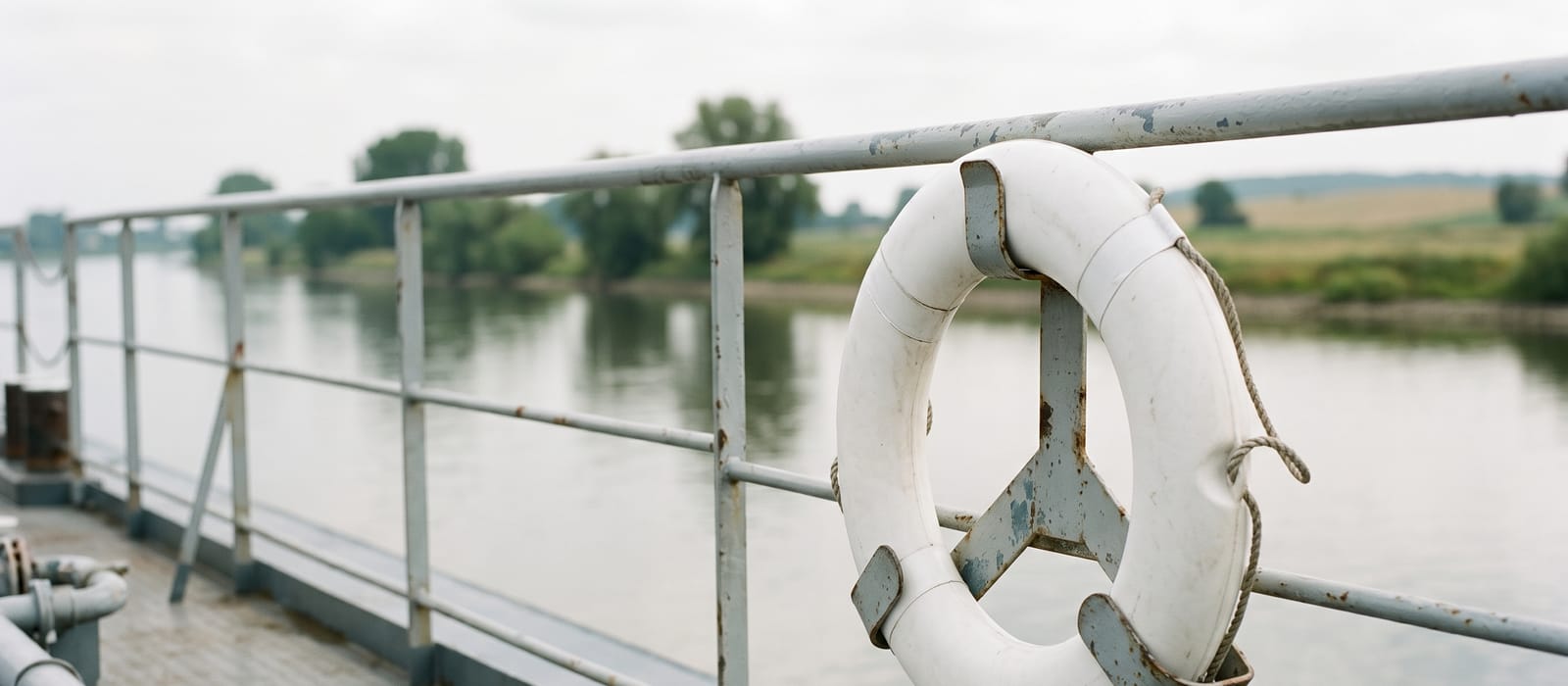
Article 13.08 requires at least three lifebuoys, either to European Standard EN 14144 or to SOLAS and the international LSA Code. They must be ready for use, attached to the deck at appropriate points but not fastened to their mountings, and at least one must sit in the immediate vicinity of the wheelhouse with a self-igniting, battery-powered light that keeps burning in water.
For lifejackets the rule is per person, not per berth: an automatically inflatable lifejacket must be within reach of every person regularly on board, conforming either to the EU personal protective equipment regulation (met by the EN ISO 12402 series) or to the LSA Code. Non-inflatable jackets are admissible for children. Jackets are inspected to the manufacturer's instructions, and an out-of-date service sticker on an inflatable jacket is exactly the kind of finding a five-minute check before the survey removes.
Do the requirements differ by vessel type?
Yes, in both directions. The anchor formulas scale with tonnage and change form for passenger vessels; lighters escape stern anchors and parts of the mooring list; small vessels may be allowed a shorter gangway by the inspection body; and the ship's boat requirement only starts at the thresholds above. Passenger vessels carry Chapter 13 as a floor, with the much heavier requirements of ES-TRIN's passenger vessel chapter on top.
The practical consequence for a mixed fleet is that no two vessels share exactly the same Chapter 13 list. The certificate entries, the formulas and the vessel's own dimensions decide what each one must carry, which is why a generic checklist reliably misses something. Article 13.02 does leave one common denominator: the outfit list applies to essentially everyone.
What changed in Chapter 13 under 2025/1?
Chapter 13's core requirements are stable; the 2025/1 edition's headline changes landed elsewhere, in propulsion, batteries and fuels, covered in what changed in ES-TRIN 2025/1. Within the fire-fighting articles, which this guide leaves to the fire protection chapter guide, the standards references continue to be updated edition by edition.
The honest note for planning: transitional provisions in ES-TRIN Chapter 32 govern when an existing vessel must catch up with a changed requirement, typically at renewal of the certificate rather than immediately. Whether a specific Chapter 13 item is due on your vessel at the next survey is a question the transitional tables answer, and worth checking before the inspection body does.