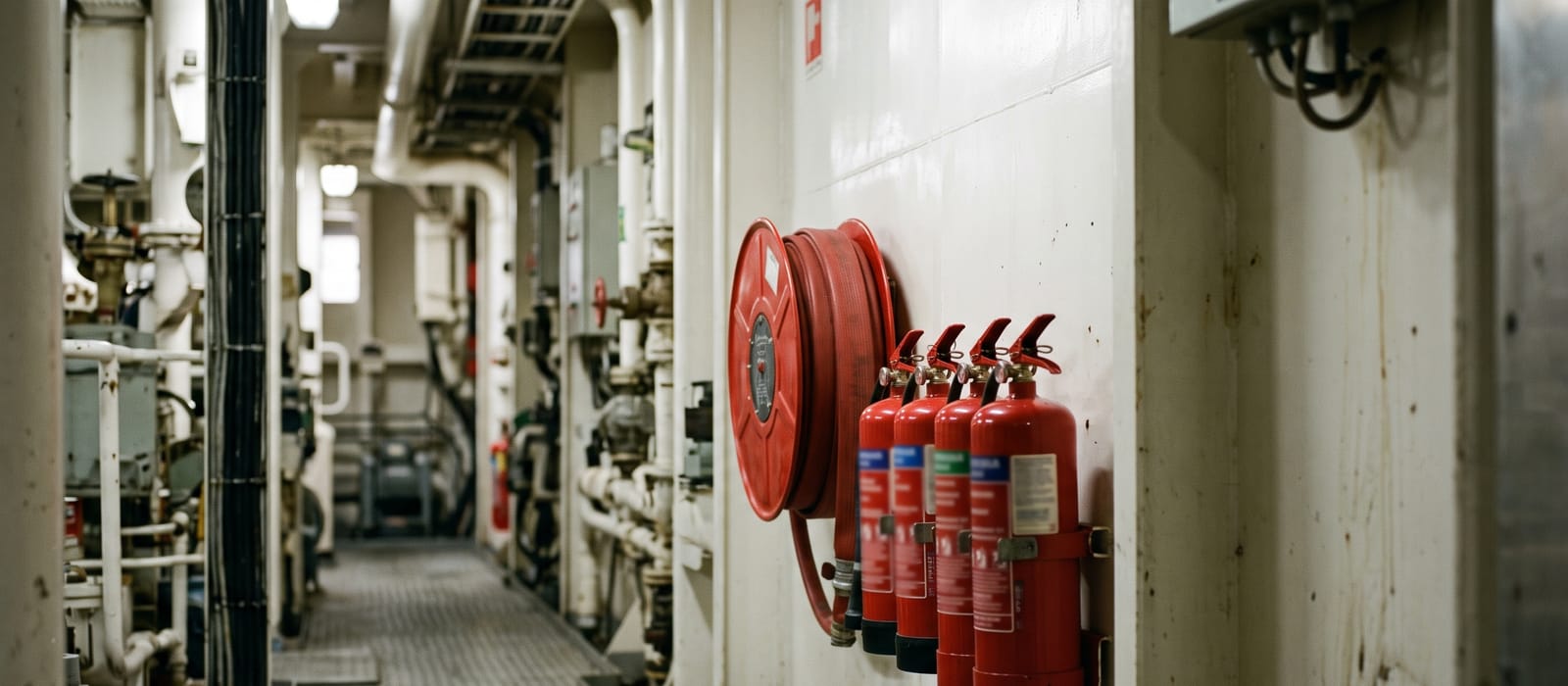
ES-TRIN regulates fire protection mainly in Articles 13.03 to 13.06: portable extinguishers, fixed systems for accommodation, and fixed systems for engine rooms. Passenger vessels carry a second layer in Chapter 19, high-speed vessels in Article 29.10, and craft burning LNG or methanol in Chapter 30.
Where does ES-TRIN regulate fire protection?
The core sits in Chapter 13, "Equipment": Article 13.03 for portable extinguishers, 13.04 for fixed systems protecting accommodation spaces, wheelhouses and passenger rooms, 13.05 for fixed systems in engine rooms, boiler rooms and pump rooms, and 13.06 for fixed systems protecting individual objects. Around that core, vessel-type chapters add their own layer: Articles 19.11 and 19.12 for passenger vessels, 29.10 for high-speed vessels, and 30.08 for craft running on low-flashpoint fuels.
This guide covers the fire-fighting requirements only. The rest of Chapter 13, anchors, lifebuoys, lifejackets and the general outfit, is covered in the Chapter 13 safety equipment guide. Both are checked at the certification inspection; the split here is editorial, not regulatory.
How many portable extinguishers does an inland vessel need?
Article 13.03(1) works by position, not by a single count. One portable extinguisher (Feuerlöscher) is required at each of these locations:
- in the wheelhouse
- close to each entrance from the deck to accommodation spaces
- close to each entrance to service spaces that hold heating, cooking or refrigeration equipment using solid or liquid fuels or liquefied gas, where those spaces are not accessible from the accommodation
- at each entrance to engine rooms and boiler rooms
- at suitable points below deck in engine and boiler rooms, so that no position in the room is more than 10 m walking distance from an extinguisher
The minimum count therefore depends on layout: a small motor barge might carry three or four, a vessel with more entrances carries more.
The standard unit under Article 13.03(2) is a powder extinguisher with at least 6 kg content, suitable for fire classes A, B and C and for fires in electrical systems up to 1000 V, conforming to EN 3-7 and EN 3-8. Vessels without a liquefied gas installation may instead carry frost-proof AFFF spray-foam units of at least 9 litres. Portable CO2 extinguishers are restricted to galleys and electrical installations, capped at 1 kg of agent per 15 m3 of the room they serve. Where fat fires are likely, the inspection body can require class F units.
Maintenance is a fixed rhythm: every extinguisher is checked at least every two years by a competent person, who signs a dated inspection label affixed to the unit itself. During a pre-inspection walk-through, those labels are the fastest fire-safety check on the vessel. An extinguisher whose label has aged past two years is a finding waiting to be written.
One phrasing note worth getting right: ES-TRIN never names halon. Older agents are excluded because Articles 13.03 and 13.05 list what is permitted, and nothing outside those lists qualifies.
What applies to fixed fire-fighting installations?
It depends on what the installation protects. For accommodation spaces, wheelhouses and passenger rooms, Article 13.04 permits exactly one technology: automatic pressurised water sprinkler systems, delivering at least 5 l/m2 per minute over the largest protected room. Lower application rates need type approval under IMO Resolution A.800(19) or an equivalent recognised standard.
For engine rooms, boiler rooms and pump rooms, Article 13.05(1) permits six extinguishing agents:
| Agent | Key requirement in Article 13.05 |
|---|---|
| CO2 | At least 40 percent of the room's gross volume within 120 seconds |
| HFC-227ea | At least 8 percent concentration within 10 seconds, capped at 10.5 percent |
| IG-541 | 44 to 50 percent concentration within 120 seconds |
| FK-5-1-12 | At least 5.5 percent within 10 seconds, capped at 10 percent |
| Water mist | Droplet size 5 to 300 microns, type-approved per IMO MSC/Circ.1165 |
| K2CO3 aerosol | At least 120 g per m3 of net volume, type-approved per IMO MSC/Circ.1270 |
Two design rules shape everything else. Automatic triggering of these room-protection systems is prohibited under 13.05(5): release is manual, from outside the protected room, preceded by an acoustic and optical warning (CO2 systems delay discharge by at least 20 seconds). Any protected room must also be monitored by a fire alarm system noticeable in the wheelhouse, the accommodation and the room itself.
The inspection cycle mirrors the portable units but is stricter about who checks. Fixed systems are checked by an expert before first use, after triggering, after major modification or repair, and at least every two years (the routine check may be done by a competent person from a specialised firm). Each check produces a signed, dated attestation, and the number of systems is entered in the vessel certificate. Keep those attestations with the certificate papers: the inspection body will ask for them by date.
Article 13.06 applies the same agent list to fixed systems protecting individual objects rather than whole rooms; automatic triggering is allowed there only when two fire detectors using different detection methods signal together.
What fire detection is required?
Detection is required where a specific article says so, not vessel-wide. The triggers in ES-TRIN 2025/1:
- Article 13.05(3): every engine, boiler or pump room protected by a fixed extinguishing system.
- Article 19.11(18): on passenger vessels, lounges not constantly supervised by crew or shipboard personnel, galleys, engine rooms and other rooms presenting a fire risk. The alarm and its detection zone must display automatically at a permanently manned location.
- Article 29.10(1): on high-speed vessels, corridors, public rooms and accommodation, galleys and engine rooms.
- Article 30.08(2): on craft with low-flashpoint fuel systems, all rooms of the propulsion and auxiliary installation where fire cannot be excluded.
What counts as an "appropriate fire alarm system" is defined in instruction ESI-II-12 in the annexes: detectors (heat, smoke, ion, flame, pressure, combustion gas or combinations), manual call points, a central unit and defined detection zones.
Note what is absent: no article in ES-TRIN 2025/1 requires smoke detectors in passenger cabins. Whether cabins count as "rooms presenting a fire risk" under 19.11(18) is for the inspection body to read, so do not treat a cabin detection finding as impossible.
How do the rules differ for passenger vessels?
Passenger vessels carry everything above plus Articles 19.11 and 19.12. Article 19.11 is structural: rooms are classified by fire risk, and the partitions between them must meet fire-resistance grades from A60 down to B0, set out in tables that relax when both sides of a partition are sprinklered. Galley ventilation needs fire dampers, and control centres, stairwells and internal muster areas need smoke extraction.
Article 19.12 scales the fire-fighting outfit to the passenger load:
- additional portable extinguishers: one per 120 m2 of gross floor area in passenger rooms, one per group of 10 cabins (rounded up), and one in each galley, with a fire blanket in every galley, hairdressing salon and perfumery
- a hydrant system: two motor-driven fire pumps, permanently connected 20 m hoses, every point on the vessel reachable from at least two hydrants, 300 kPa at the hydrant and a 6 m water jet on all decks
- a fixed extinguishing system per Article 13.05 in the engine room
- on cabin vessels: two self-contained breathing apparatus sets, two firefighter equipment sets and four smoke hoods
For an operator, 19.12 is where pre-inspection effort pays: extinguisher counts, hose condition, pump starts and breathing apparatus service dates are all walkable, dated evidence.
What changed for fire protection in 2025/1?
One substantive change, aimed at modern construction materials. Edition 2025/1 introduces a "fire-restricting" material definition in Article 1.01, reworks the test-method list and partition tables in Article 19.11 (including a new equivalence table for partitions not made of steel), and adds Article 19.11(19): passenger vessel rooms built of combustible materials such as fibre-reinforced plastic composites must be protected by a fixed firefighting system under Article 13.04 or 13.05. The package traces back to CCNR recommendations for FRP and aluminium passenger vessel construction.
Articles 13.03 and 13.04 are untouched, and the 2025/1 amendments to 13.05 are editorial corrections in the French and Dutch language versions only. The new methanol provisions in Chapter 30 and Annex 8 carry their own fire-safety requirements, covered with the rest of the edition in what changed in ES-TRIN 2025/1.
Fire protection is the part of ES-TRIN where evidence ages fastest: labels expire and attestations fall due. The articles themselves change slowly, as 2025/1 shows. The work is keeping the two-year clocks visible, and that is a fleet-office job as much as a crew job.