Fire safety is the most common PSC deficiency area, at 16.83% of the 51,797 deficiencies Paris MoU officers recorded in 2025. Ship structure, crew health and welfare under MLC, life-saving appliances and safety of navigation complete the top five. The single most recorded individual deficiency is the ISM Code itself.
What are the most common PSC deficiencies?
The Paris MoU 2025 annual report ranks its deficiency "main groups" like this:
| Rank | Area (convention chapter) | Deficiencies | Share |
|---|---|---|---|
| 1 | Fire safety (SOLAS II-2) | 8,713 | 16.83% |
| 2 | Ship structure, machinery, electrical (SOLAS II-1) | 6,004 | 11.60% |
| 3 | Health protection, medical care, welfare (MLC Title 4) | 5,225 | 10.09% |
| 4 | Life-saving appliances (SOLAS III) | 4,815 | 9.30% |
| 5 | Safety of navigation (SOLAS V) | 3,952 | 7.63% |
The Tokyo MoU's 2025 figures tell the same story with different weights: fire safety leads there too at 19.98%, followed by life-saving appliances at 13.11%, and the top four categories account for over half of all 90,168 deficiencies recorded in the region.
Ranked lists are useful for one thing above all: they are the closest public record of where officers actually look. A crew that works through fire safety, life-saving appliances and its own paperwork before a port call has covered the ground where most findings live. The five-digit codes behind these categories are explained in PSC deficiency codes explained.
Why do ISM and safety-management deficiencies top the list?
Because ISM findings are where other findings end up. In the Paris MoU 2025 statistics the ISM Code is the most recorded individual deficiency, with 2,322 findings, 4.48% of everything recorded that year. In the Tokyo MoU region, the two ISM-related lines (ISM itself, and maintenance of the ship and equipment under ISM) sit high on the list of most frequent detainable deficiencies, with 200 and 104 cases respectively.
The mechanics explain the ranking. A rusted fire damper is a fire-safety deficiency. Three rusted dampers, a lapsed drill record and an unfamiliar crew are evidence that the Safety Management System does not work on this ship, and that becomes an ISM finding on top of the hardware findings. Paris MoU guidance is explicit that a serious failure in implementing the ISM Code is a ground for detention in itself, which is why ISM tops detention statistics even where it does not top raw deficiency counts.
Avoiding ISM findings is therefore mostly indirect: keep the hardware findings singular. One deficiency is a defect; a pattern is a system failure. The pre-inspection habit that matters most is fixing recurring items properly and recording the fix, so no officer can trace the same finding across two visits.
Which fire-safety deficiencies keep recurring?
Fire doors. The second most recorded individual deficiency in the whole Paris MoU system in 2025, at 1,609 findings, is fire doors and openings in fire-resisting divisions: doors lashed open, self-closing mechanisms disabled, gaskets perished. In the Tokyo MoU the detainable end of fire safety is led by fixed fire-extinguishing installations (215 cases), with fire pumps and piping, fire detection and alarms, and fire dampers all in the top ten.
The pattern behind these numbers is that fire-safety items fail quietly between inspections. A damper seizes, a door gets wedged for ventilation, a nozzle gets painted over, and nothing announces it until someone operates the item. Which is exactly what the officer does. The counter is operational: walk the fire plan and physically operate doors, dampers and at least one hydrant on each round rather than sighting them. Check the servicing dates on extinguishers and the fixed system while you are there. A fire door that closes by itself is not a finding; nearly everything else it might do is.
Which life-saving appliance faults get flagged most?
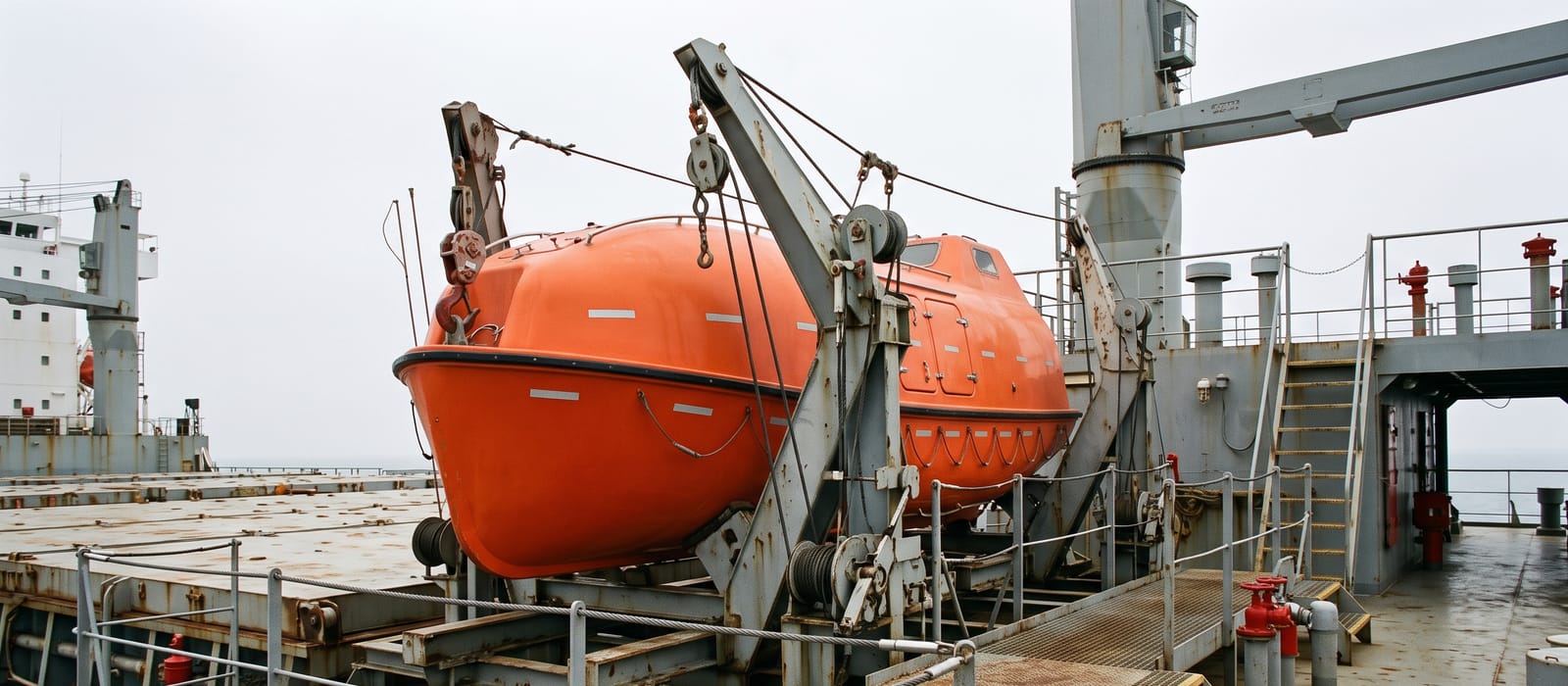
Lifeboats and their launching arrangements are the sharp end. Life-saving appliances produced 4,815 Paris MoU deficiencies in 2025, 9.30% of the total, and in the Tokyo MoU region lifeboats are the third most frequent detainable deficiency at 152 cases. The recurring physical faults are familiar to any superintendent: davits and winches with overdue servicing, on-load release gear out of certification, engines that will not start, and equipment inside the boat expired or missing.
What makes LSA findings expensive is that a lifeboat that cannot be launched fails the abandon-ship test in the detention criteria, so these findings sit close to the detainable line, and the crew's ability to demonstrate the appliance matters as much as its condition. Run launch-and-recover drills within the required intervals, keep the maintenance record with the boat where it can be produced, and treat every expiry date inside the boat (rations, pyrotechnics, first aid) as a checklist line, not a discovery.
Which MARPOL and oil record book issues trip up crews?
MARPOL Annex I, the oil pollution rules, produced 1,593 Paris MoU deficiencies in 2025, and in the Tokyo MoU region oil filtering equipment, in practice the oily water separator and its alarm, is the tenth most frequent detainable deficiency, with 92 cases. Pollution findings escalate faster than their raw numbers suggest, because a pollution risk fails the detention test directly.
The Oil Record Book is the paperwork half of the same story. Officers cross-check its entries against sounding logs, tank capacities, the separator's running hours and bunker delivery notes, and an entry that does not reconcile reads as a possible illegal discharge rather than sloppy bookkeeping. The annual reports do not itemize record book findings separately, but the avoidance rule does not need statistics: the book, the logs and the equipment must tell one consistent story, and the officer must be able to watch the separator run. Worth watching too: ballast water management findings are climbing in both regions, 3.1% of Paris MoU deficiencies in 2025 (up from 1.9%), and they tripled year-on-year in the Tokyo MoU region after the 2025 concentrated inspection campaign put them in focus.
Do deficiency patterns differ by vessel type?
Detention rates certainly do. The 2025 Paris MoU average detention rate was 4.18%, but general cargo and multipurpose ships were detained in 6.78% of their inspections (283 detentions from 4,173 inspections), the highest of any high-volume type. Bulk carriers came in at 5.38%. The tightly vetted trades sit far below the line: oil tankers at 2.68%, container ships at 1.98%, gas carriers at 1.40%.
The spread mostly tracks age and commercial scrutiny. Tanker and gas fleets face SIRE and CDI vetting on top of PSC, so their hardware gets audited between port calls; the general cargo fleet is older on average and answers to no charterer's vetting programme. For a crew, the practical conclusion is to prepare against the list for your own ship type rather than a generic one, which is what our pre-inspection checklist by vessel type is for. And because detention is the outcome all five areas feed, it is worth knowing what a detention actually costs before treating any of them as minor.
One caveat belongs on all of these numbers: they describe fleets, not your ship. A gas carrier's 1.40% detention rate buys no slack for the one with a seized damper. The lists tell you where officers find problems; whether they find them on your ship is decided in the week before the port call.