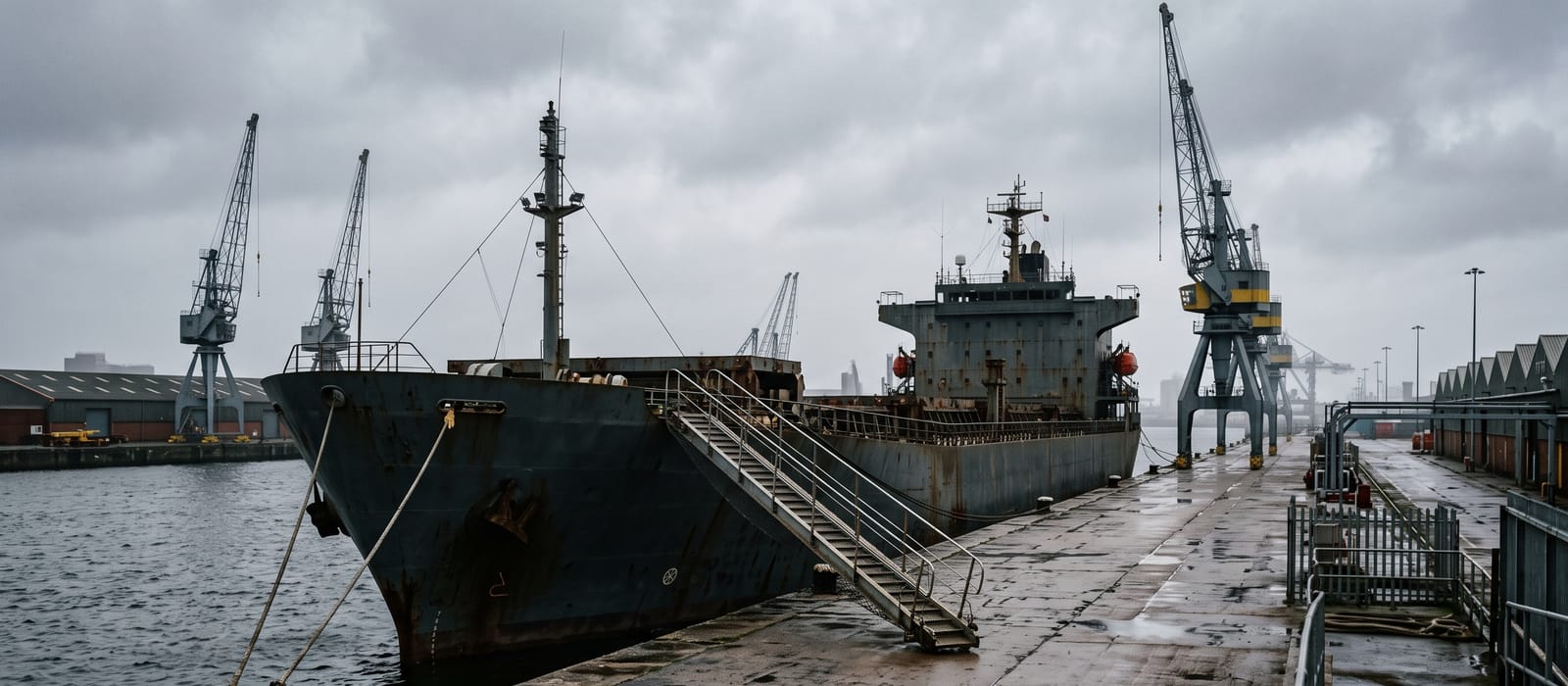
A Port State Control detention holds the ship in port until its deficiencies are rectified and, for the serious ones, verified on board by a returning officer. Industry estimates put the direct bill for a typical 48 to 72 hour detention between EUR 75,000 and EUR 250,000. The record it leaves behind costs more.
What does it mean when a ship is detained?
Detention means the port state has decided the ship is unfit to sail until specific deficiencies are put right. The officer marks each deficiency that justifies the intervention as grounds for detention, the ship stays where it is, and under Paris MoU procedure the officer comes back on board to confirm the rectification before releasing her. If repairs cannot be done locally, the port state can agree to let the ship sail to a repair yard under action code 46, with conditions attached. How a routine boarding escalates to this point is worth understanding in its own right.
Two details of the procedure surprise operators the first time. First, the money: the Paris MoU Memorandum charges all costs of a detention-related inspection to the owner or operator, and the detention is not lifted until they are paid or guaranteed. Second, the appeal: only the flag state or the recognised organisation can bring a case to the Paris MoU review panel, within 120 days of release, and the panel's findings are not binding. The ship stays detained while any appeal runs, and the entry stays on the ship's public inspection record unless the detaining authority itself amends it. There is no route by which a detention is argued away after the fact.
How much does a detention cost per day?
Off-hire alone is typically quoted between EUR 20,000 and EUR 150,000 per day, depending on vessel type and the state of the market. On top of that sit port dues and shifting costs, agency fees, riding repair teams mobilised at short notice, class and flag attendance, and the port state's own re-inspection, which the owner pays for. A "typical" detention resolves in two to three days; RightShip's analysis of 2025 PSC data puts the average time lost at 5.6 days per detention event, because the tail of long cases drags the mean up. Those long cases, where a structural or ISM problem cannot be fixed alongside, are the ones that pass EUR 1 million.
The honest answer for any specific ship depends on her day rate and where she is held. The detention cost calculator lets you put in your own vessel type, day rate and detention length and see the range for your case rather than an industry average.
What commercial fallout follows a detention?
The charterparty consequence is usually automatic. NYPE 2015, the most common dry time charter form, names "detention by Port State control or other competent authority for Vessel deficiencies" as an off-hire event in clause 17. Hire stops, the owner's costs do not, and the charterer may also claim for cargo delays depending on the terms. Whether a given detention is off-hire always turns on the clause as amended and on causation, but on the standard wording the owner starts from a losing position.
The visibility consequence lasts longer. Paris MoU inspection results are published on its website, the Tokyo MoU's APCIS database publishes in real time, and both feed Equasis, which anyone can search. RightShip folds PSC performance into the vetting data that major dry bulk charterers screen against, and tanker operators get asked about detention history in vetting even though SIRE and PSC are separate regimes. Nothing about a detention stays between the ship and the port state: every prospective charterer can read the entry for the next three years, and in 2025 the Paris MoU also issued 19 banning orders, each one published by name.
Which deficiencies most often lead to detention?
The same categories lead the deficiency tables year after year. From the Paris MoU 2025 annual report:
| Deficiency category | Share of all deficiencies, 2025 |
|---|---|
| Fire safety (SOLAS Ch II-2) | 16.8% |
| Structure and electrical (SOLAS Ch II-1) | 11.6% |
| Health, medical care, welfare (MLC Title IV) | 10.0% |
| Life-saving appliances (SOLAS Ch III) | 9.3% |
| Safety of navigation (SOLAS Ch V) | 7.6% |
| ISM Code | 4.5% |
The ISM share understates its weight in detentions. Class society guidance is blunt about the pattern: an ISM detention usually sits on top of an accumulation of individual deficiencies, because a ship with failed fire doors, expired extinguishers and gaps in the drill records has demonstrated that the safety management system behind them is not working. The individual items get their own codes; the cluster gets the detention. Our guides to the deficiency areas that recur fleet after fleet and how deficiency codes are read break down where those clusters come from.
How does one detention change future inspections?
A detention feeds straight into the Ship Risk Profile, which the Paris MoU recalculates from the ship's previous 36 months of history along with flag, class and company performance. A high-risk ship is targeted for inspection every 5 to 6 months and is eligible for expanded inspection each time; a low-risk ship might see an officer every 24 to 36 months. One detention can move a vessel across that spectrum, and the inspections it attracts arrive during working cargo calls, with all the disruption that brings. The Ship Risk Profile explained covers the exact parameters.
More inspections also mean more exposure to themed campaigns. During a concentrated inspection campaign, every port call in the September to November window adds a topic questionnaire to the normal scope; the 2026 joint Paris and Tokyo MoU campaign targets cargo securing. And repeat detentions escalate past inspection frequency altogether. Under the Paris MoU banning criteria, three detentions within 36 months for a ship flying a black-listed flag, or within 24 months for a grey-listed flag, trigger a refusal-of-access order covering the whole region. The first ban can be lifted after 3 months at the earliest, the second after 12, the third after 24 and only under strict conditions. A further detention after the third ban means the ship is refused access permanently.
How do operators cut detention risk before the officer boards?
Almost everything in the deficiency tables above is findable by the crew in the week before arrival. Most crews already walk the ship before an expected inspection; the failure mode is that the walk-through leaves no record, the office cannot see what was checked, and the item that was marginal last quarter gets rediscovered by the officer instead of the crew. A pre-inspection that works uses a structured routine matched to the vessel and the regime, captures evidence per item, and closes gaps before the boarding rather than after it. When a deficiency is found anyway, closing it out properly is what keeps one finding from becoming a pattern. The rest of the PSC guide series covers each step.