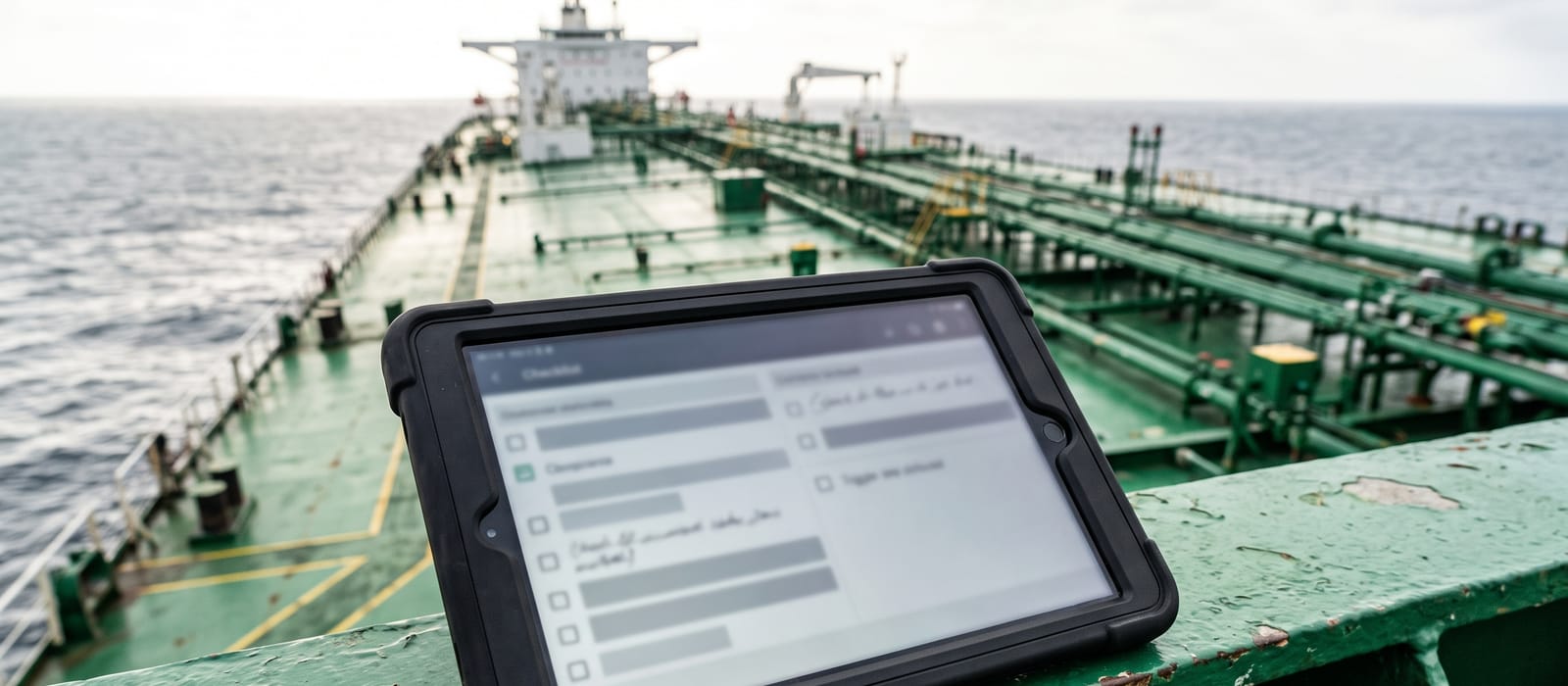
The CVIQ, the Compiled Vessel Inspection Questionnaire, is the question set a SIRE 2.0 inspector brings on board. OCIMF's compiler software assembles it fresh for each inspection from the SIRE 2.0 question library, using the vessel's type, its declared particulars (HVPQ) and the operator's pre-inspection questionnaire (PIQ).
What is the CVIQ?
A CVIQ is a one-time questionnaire: built for one vessel, used for one inspection, then never used again in that exact form. It is the working document of every SIRE 2.0 inspection, loaded onto the inspector's intrinsically safe tablet, and it defines what will be looked at, which documents will be sampled and which crew members will be asked to demonstrate what.
That makes it a different animal from the questionnaire it replaced. The old VIQ7 was a fixed, published list; an operator could open it, walk the ship against it, and know the inspection's full scope in advance. A CVIQ removes that certainty on purpose. The full comparison between the two regimes is in SIRE 2.0 vs the old SIRE (VIQ7); in one line, the questionnaire stopped being a document and became an output.
How is a CVIQ generated for each inspection?
When an inspection is commissioned, OCIMF's inspection compiler runs an algorithm over the question library and selects the questions that apply to this vessel on this occasion. The library, published by OCIMF in two parts covering twelve chapters, holds far more questions than any single inspection uses, each tagged with the vessel types and configurations it applies to.
The compiled set follows a fixed logic. Core questions, the minimum set OCIMF defines as required to meet its fundamental risk assessment criteria, are included wherever they apply to the vessel. Around them the compiler allocates rotational questions in deliberately unpredictable patterns, adds conditional questions when specific HVPQ or PIQ responses trigger them, and includes any campaign questions OCIMF has activated industry-wide for a fixed period. What each of those categories does, and how a question ends up in one of them, is covered in the four SIRE 2.0 question types.
The result is downloaded to the inspector's tablet, which syncs before the visit and works offline during it. The crew meets the question set for the first time when the inspector starts working through it.
What data feeds the compilation (HVPQ, PIQ)?
Three inputs matter: the vessel's type, the HVPQ and the PIQ.
The Harmonised Vessel Particulars Questionnaire records the permanent and infrequently changing facts of the vessel: construction, outfitting, equipment and certification. It tells the compiler what kind of ship this is and what is fitted on board, which determines which library questions can apply at all. A question about a piece of equipment the HVPQ does not declare will not normally be compiled; a question about equipment it does declare can be.
The Pre-Inspection Questionnaire is an online questionnaire the operator completes for the inspection, supplementing the HVPQ with current information about the vessel and its recent operations. Where the HVPQ describes what the ship is, the PIQ describes what it has been doing, and specific PIQ responses can trigger conditional questions that verify operational history or operator oversight.
Both documents are the operator's own work, which means the operator co-authors the inspection scope before an inspector is even assigned. The discipline this demands is the subject of keeping PIQ and HVPQ data accurate.
How many questions does a CVIQ typically contain?
OCIMF does not publish a fixed count, and it varies by vessel and occasion. In practice, operators and industry guidance describe compiled sets in the region of 100 questions, sized so the physical inspection fits a working day on board. A larger or more complex vessel, or one whose data triggers conditional material, can draw more.
The count is also a poor measure of workload. A single SIRE 2.0 question can be assessed through hardware, process and human response tools, each capable of producing its own observation, so one compiled question can mean an equipment check, a procedure review and a crew demonstration. Measured in effort rather than lines, a CVIQ is a full inspection regardless of where the count lands.
Why is every CVIQ different?
Because unpredictability is a design goal, not a side effect. OCIMF built the rotational allocation to vary in patterns operators cannot anticipate, precisely so that crews prepare the ship rather than a list. Three ships of the same class inspected in the same month will face three different questionnaires.
The variation has four sources. Vessel particulars differ, so the applicable question pool differs. Rotational selection changes from inspection to inspection by design. Conditional triggers depend on each ship's own declared history. And campaign questions come and go on OCIMF's schedule, appearing in every inspection for a period and then dropping out.
For preparation this cuts one way: since the drawn subset cannot be predicted, readiness has to hold across the whole applicable scope. A crew-run walk-through that covers the vessel systematically, documented as it goes, is the working answer, and preparing crew and vessel for the CVIQ sets out what that looks like.
What happens when the PIQ or HVPQ data is wrong?
The inspection arrives built on the wrong foundation. Because the compiler trusts the declared data, errors propagate straight into the question set. Equipment wrongly declared as fitted can compile questions the crew must answer about hardware that does not exist; equipment wrongly omitted can leave real risk areas unexamined until the inspector notices them anyway. Stale PIQ entries can fire conditional questions about operations the ship never performed, or fail to fire ones it should face.
On board, the mismatch surfaces immediately, because the inspector is holding the vessel's declared picture while standing in the actual one. Discrepancies between the two invite exactly the scrutiny an operator least wants: questions about how the vessel's data is managed, which is an operator-oversight matter, answered under observation. A question the CVIQ asked because the data was wrong can still end as a negative observation in the report, and that report publishes to the database charterers screen against, as covered in how negative observations feed charterer screening. The operator's 14-day comment window can add context to an observation; it cannot recompile the questionnaire that produced it.
The fix is unglamorous: treat the HVPQ and PIQ as inspection documents with an owner, a review cycle and evidence behind each entry, not as forms to be filled from memory. Data accuracy is the one part of a SIRE 2.0 inspection the operator controls completely, and it is decided weeks before the inspector boards.