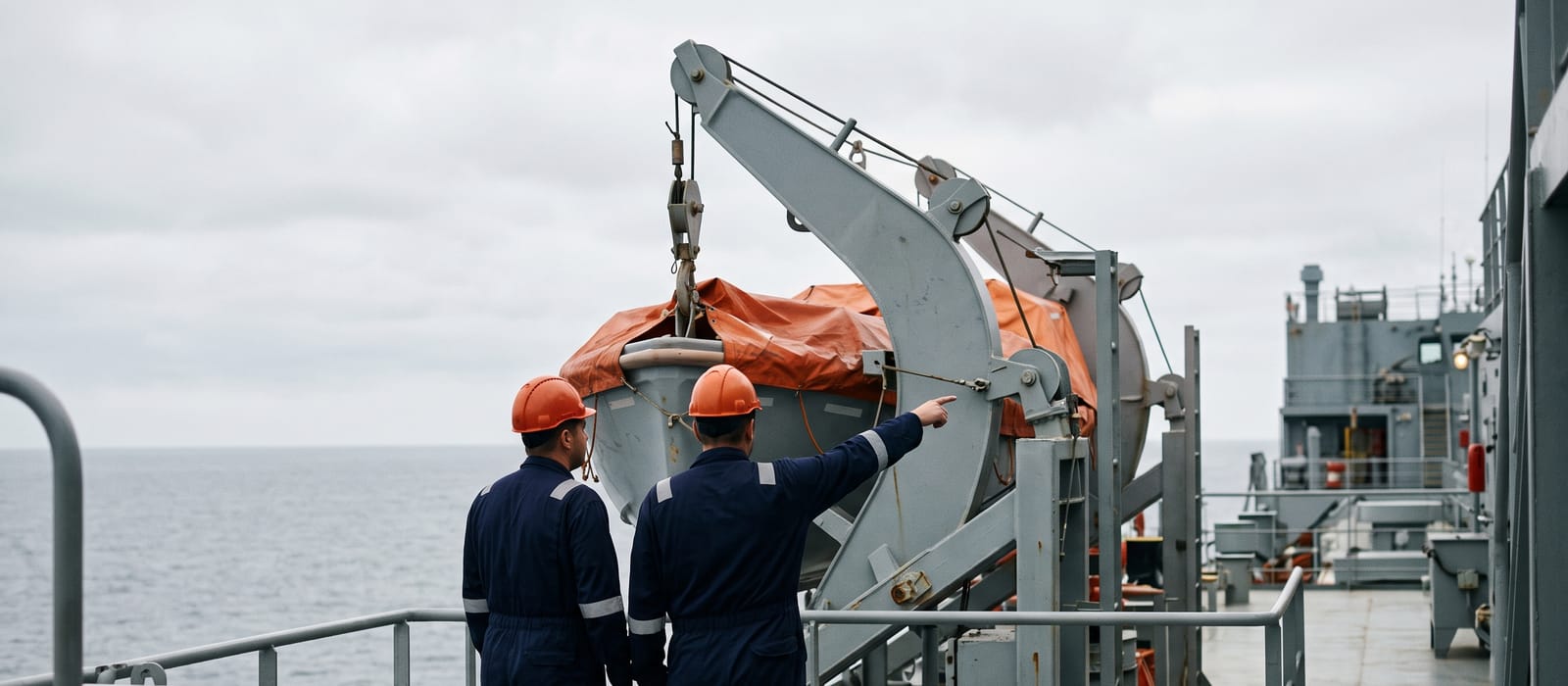
SIRE 2.0 assesses the crew directly. Where a question carries a human element, the inspector watches a crew member perform a task or answer questions, rates the response against expectation, and for any rating other than "as expected" must record which of nine Performance Influencing Factors shaped the result.
How does SIRE 2.0 assess the human element?
Through a dedicated human response tool. OCIMF describes human factors as the third leg of the stool: SIRE began with hardware, procedures were addressed later, and SIRE 2.0 added the people who operate both. Where a question or its guidance refers to the familiarity of vessel staff with a company procedure or the operation of equipment, the inspector uses the human response tool to record how the interaction went.
The person being observed is recorded by rank group, not by name. OCIMF's negative observation module defines five groups: senior deck officer, junior deck officer, senior engineer officer, junior engineer officer, and rating. A charterer reading the report sees that a junior engineer officer was unfamiliar with a procedure; they never see who. The assessment targets how the operator trains and supports a rank on that vessel, not the individual who happened to be on watch.
Which human-element questions appear at all depends on the vessel data your office maintains, because the CVIQ is compiled per vessel. That data trail is covered in PIQ and HVPQ accuracy.
What are performance influencing factors (PIFs)?
OCIMF defines Performance Influencing Factors as "a collective term for those factors that are known to influence or shape human performance. They can enhance and assist human performance, or they can degrade and obstruct it." When an inspector rates a response, the PIF is the recorded reason: what made this crew member perform well or poorly.
The negative observation module lists nine, plus a fallback for cases where no factor could be identified:
| # | Performance Influencing Factor | What the inspector is looking at |
|---|---|---|
| 1 | Recognition of safety criticality of the task or associated steps | Does the person understand why the task matters? |
| 2 | Custom and practice surrounding use of procedures | Is the written procedure actually the way work is done? |
| 3 | Procedures accessible, helpful, understood and accurate for task | Can the procedure be found, followed and trusted? |
| 4 | Team dynamics, communications and coordination with others | Do the people involved work and talk as a team? |
| 5 | Evidence of stress, workload, fatigue, time constraints | Is the person overloaded or short of rest? |
| 6 | Factors such as morale, motivation, nervousness | Is the state of the person affecting the response? |
| 7 | Workplace ergonomics including signage, tools, layout, space, noise, light and heat | Does the working environment help or hinder? |
| 8 | Human-machine interface, such as controls and alarms | Is the equipment itself confusing to operate? |
| 9 | Opportunity to learn or practice | Has the person ever had the chance to do this before? |
Read the list again and notice what is not on it: competence, attitude, negligence. The PIFs are conditions, most of them set by the company rather than the crew member. A procedure nobody can find, a fatigued watchkeeper and an alarm panel that confuses its operator are management findings expressed through a person.
How does an inspector rate a crew response?
On a four-level scale, and only the middle-ordinary level stands alone:
| Rating | Applies to | What the inspector must record |
|---|---|---|
| Exceeds expectations | Human responses only | One or more PIFs plus a supporting comment |
| As expected | All response tools | Nothing further |
| Largely as expected | Human responses | One or more PIFs plus a supporting comment |
| Not as expected | All response tools | A negative observation with full coding |
Two things follow from the table. First, SIRE 2.0 can record genuinely good performance: "exceeds expectations" exists for human responses and nowhere else, so a sharp, confident demonstration ends up in the report as a positive observation. Second, "largely as expected" is not a pass with a shrug. It carries a PIF and a comment, which means a partly hesitant answer still leaves a written trace of why.
The response tools themselves differ by subject. Hardware and process questions take binary or graduated responses against the observable condition of equipment and documents; the crew-facing scale above belongs to the human tool. How the three interlock across a single question is covered in the CVIQ question types explained.
What follows a below-expectation rating?
A negative observation, recorded in a fixed structure. The inspector identifies the Subject of Concern (for a human response, the rank group), the Nature of Concern (one or more PIFs), and writes a negative comment describing the observed conditions in detail. OCIMF built this coding so reports can be data-mined: a charterer's vetting team can query patterns across a whole fleet's human-factors record rather than read reports one at a time.
Two consequences deserve attention. Negative observations against core questions remain visible to the next inspector, so a human-factors finding follows the vessel into its next inspection. And the published report is what charterers screen against; how negative observations feed charterer screening covers that path.
The operator is not silent in this process. From the day the submitting company releases the report, the operator has 14 days to attach structured comments to each negative observation: immediate cause, root cause, corrective action and preventative action. Once published, the report cannot be amended, only withdrawn.
How is this different from the old VIQ approach?
VIQ7 asked mostly binary questions and recorded deficiencies as free text. The human element was present in practice, since inspectors have always talked to crews, but it was not systematically observed, rated or coded. A crew that interviewed badly might attract observations; a crew that interviewed well earned nothing the report could show.
SIRE 2.0 changes both ends. Good human performance is now reportable, and poor performance is coded to a cause rather than left as an inspector's prose. The graded scale also removes the cliff edge of yes/no: an officer who knows the procedure but hesitates on one step lands at "largely as expected" instead of failing outright. The full comparison, including what happened to the fixed questionnaire, is in SIRE 2.0 versus VIQ7.
How should a crew prepare for human-factors questions?
Prepare people the way you prepare equipment: area by area, with a test at the end.
Brief officers per area. Each officer should know which question domains touch their role, and what the expected demonstration looks like for each. A chief officer preparing mooring questions and a second engineer preparing purifier questions are doing different homework; a general all-hands briefing does neither well.
Demonstrate rather than describe. The human response tool measures familiarity in use, not recall. An officer who operates the equipment while explaining it will read very differently from one who recites the manual beside it. Practise the demonstration itself, hands on the actual controls, until it is routine.
Walk the questions beforehand. Run the likely interviews as a dry run during the pre-inspection walk-through, with another officer playing the inspector. This is where gaps surface while they can still be closed, and it doubles as rehearsal for the format. That matters because nervousness sits on the PIF list: an unfamiliar, tablet-driven interview can rattle a competent officer, and OCIMF produced a set of human factors training videos for masters, officers and crew precisely so the format is not a surprise. They are free on the OCIMF website and are designed for regular viewing on board.
None of this is about scripting answers. Inspectors assess familiarity, and a scripted answer collapses at the first follow-up question. The aim of the walk-through is to find the officer who genuinely does not know the procedure before the inspector does, and fix that. The wider run-up, office work included, is laid out in the SIRE 2.0 preparation checklist.
A last point worth sitting with: the PIF list is a fair description of why good people underperform, and most of its nine entries are within the company's control. Crews do not fail SIRE 2.0 human-factors questions alone.